Quality Assurance in world of AI
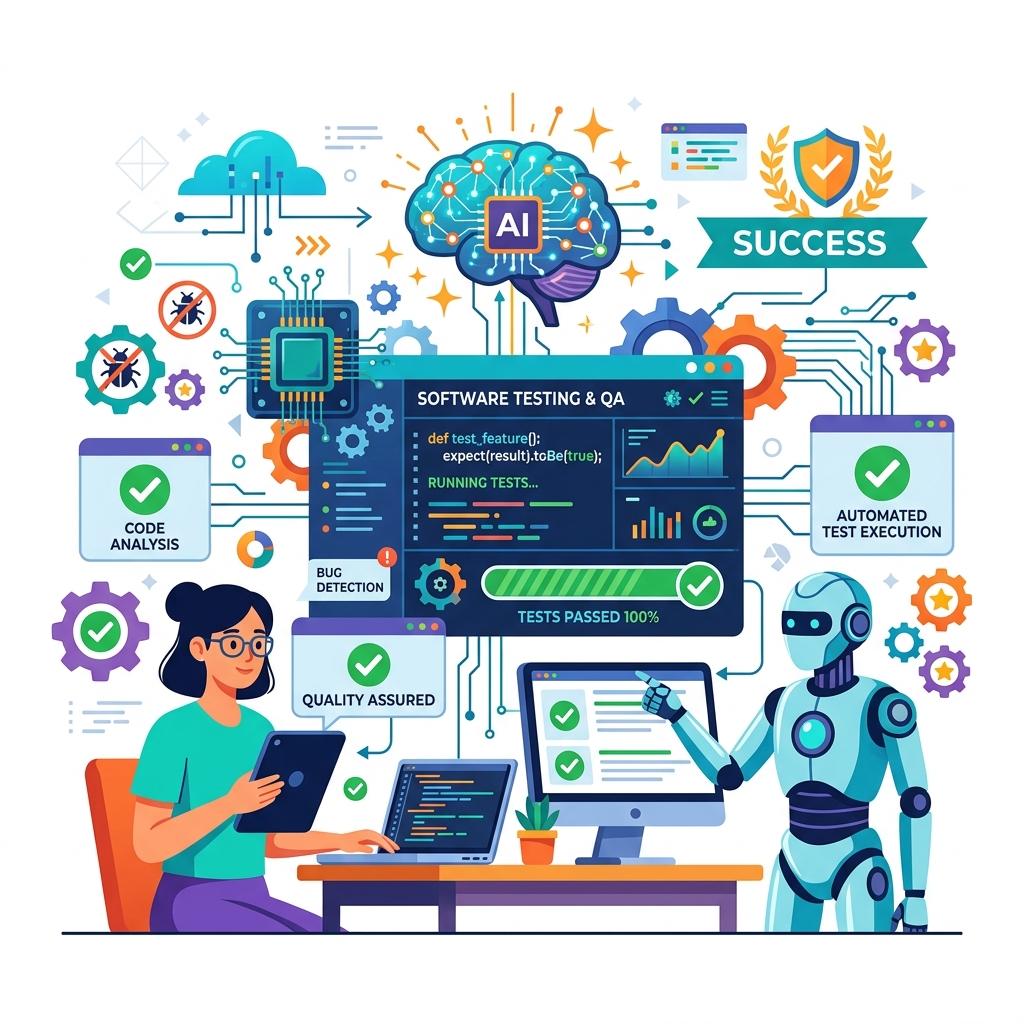
The integration of Artificial Intelligence (AI) and Machine Learning (ML) into software development has introduced a paradigm shift in how we approach Quality Assurance (QA). Traditionally, QA has relied on deterministic test scripts—writing hardcoded commands to click buttons, input values, and assert outputs. However, as software systems become more complex and dynamic, these rigid automated suites suffer from high maintenance overhead, flaky failures, and narrow coverage.
AI-driven quality assurance resolves these pain points by introducing probabilistic, adaptive, and cognitive capabilities into the testing lifecycle.
AI-Driven Test Generation
One of the most promising applications of AI in QA is automated test case generation. Rather than manually scripting every user flow, AI algorithms can analyze user behavior logs, application codebases, and historical data to automatically map paths and generate testing scripts.
- User Path Discovery: AI agents observe real-world application sessions to construct usage models, identifying the most critical paths and edge cases that manual testers might miss.
- Natural Language Parsing: Using Large Language Models (LLMs), teams can input requirements in plain English, and the model automatically generates Gherkin scenarios or playwright scripts.
AI-Powered Visual Testing
Traditional pixel-to-pixel comparison in visual testing is notorious for false positives caused by minor rendering offsets, sub-pixel variations, or differences in screen resolutions.
AI visual validation algorithms emulate human vision. They utilize convolutional neural networks (CNNs) to distinguish between cosmetic adjustments (like a shifted element that is still visually correct) and layout breaking bugs (like overlapping text or missing checkout buttons). This dramatically reduces test maintenance and eliminates build blockage noise in CI pipelines.
Self-Healing Test Suites
In standard automation, minor layout or markup adjustments (such as a changing class name, ID, or CSS selector) will instantly break tests, triggering test failures and requiring manual developer intervention.
AI-powered self-healing test runners automatically analyze DOM changes at runtime. If a target element’s primary selector changes, the self-healing engine uses machine learning to identify alternative attributes (such as parent relationships, text context, or visual positioning) to locate the element, execute the click, and log a warning to update the locator later, keeping the pipeline green.
As AI continues to mature, the role of the QA engineer will shift from scripting repetitive assertions to training models, auditing predictive intelligence, and orchestrating comprehensive quality strategies.