Shift-Left Testing: Why Waiting is a Bug
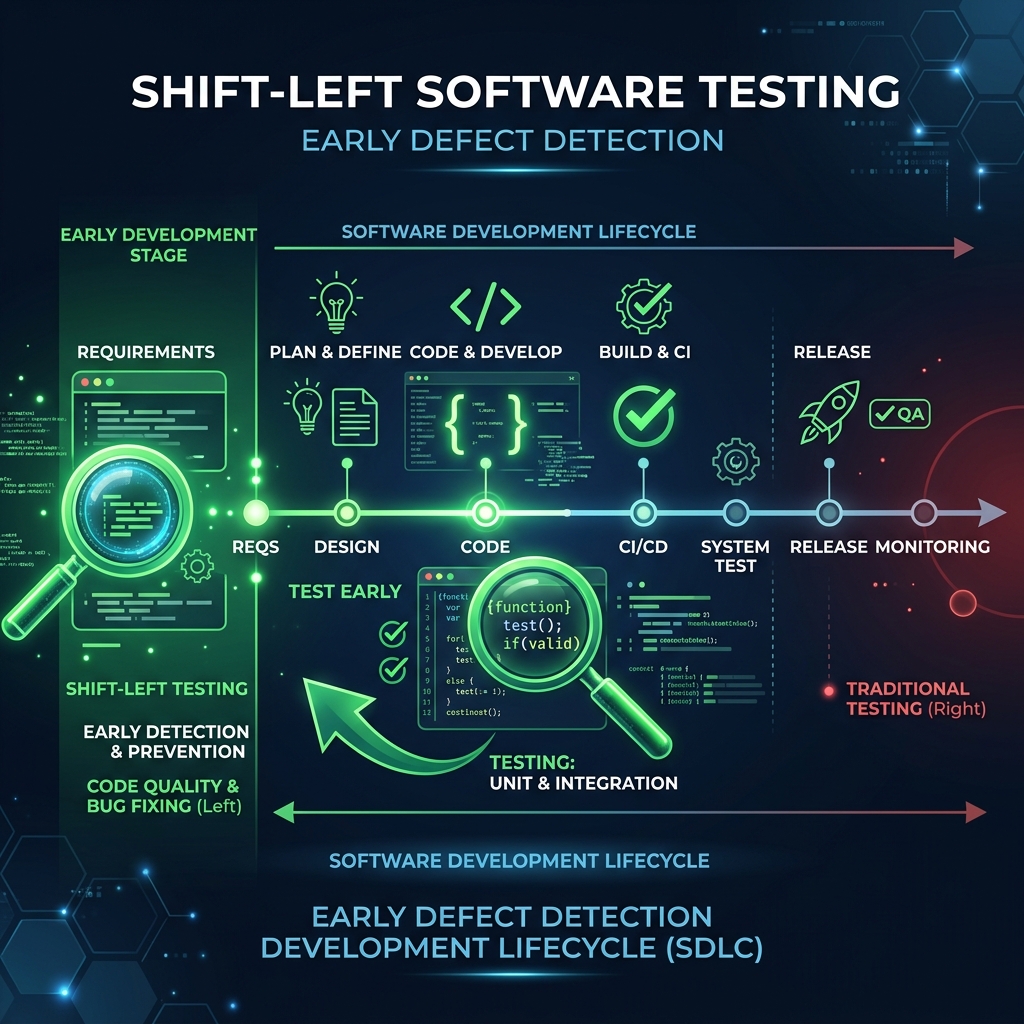
The cost of fixing a bug increases exponentially the later it is discovered in the software development lifecycle (SDLC). When testing is treated as a separate phase that occurs only after developers finish coding, quality assurance (QA) becomes a bottleneck. Even worse, architectural flaws are uncovered at a point when refactoring them is either cost-prohibitive or physically impossible.
Shift-Left Testing is the practice of moving testing activities earlier in the SDLC—literally to the left of the timeline. It bridges the gap between design and implementation, ensuring that quality is built in rather than verified after the fact.
Why Waiting is a Bug
When teams defer testing until the staging or pre-production environment, they run into three major friction points:
- Compounded Defect Complexity: A bug introduced during the requirements definition or early architectural design can manifest as dozens of minor, confusing bugs during integration testing. By the time QA engineers find these defects, tracking down the root cause is highly complex because it is buried under layers of subsequent code changes.
- High Remediation Cost: According to the Systems Sciences Institute at USC, fixing a bug in production can cost up to 100 times more than finding and fixing it during the requirements phase.
- Friction and Blame: When code is “thrown over the wall” to QA, developer context is lost. Developers are already working on new features, and context-switching back to a bug they wrote weeks ago creates cognitive load and delivery delays.
Implementing Shift-Left in Practice
Shifting left does not simply mean writing unit tests. It requires a fundamental shift in team culture and engineering practices:
- Requirements Defect Mitigation: QA engineers should participate in three-amigos meetings (Product Owner, Developer, QA) to refine user stories before code is written. If a requirement is ambiguous or untestable, it is corrected before it becomes code.
- Contract-First Development: Developers and QA collaborate to define API schemas (e.g., OpenAPI / Swagger) first. QA can write contract tests against this schema, and mock servers can be stood up to unblock frontend development.
- Local Loop Verification: Provide developers with high-fidelity local testing environments. Using tools like Docker, Docker Compose, or local database migrations ensures that integration bugs are caught on the developer’s laptop before code is pushed to Git.
- Automated Gates in CI: Unit tests, static code analysis (linters, formatting, security scanners), and smoke tests should run automatically on every pull request. No branch should be merged without satisfying quality gates.
By integrating quality checks into the daily workflow of developers and architects, teams build resilient systems, lower engineering stress, and deliver reliable software.